Going vegetarian
I am going genAI-vegetarian. That means I will try my best to avoid consuming the products of generative AI, like an email touched up with ChatGPT, a lede illustration generated from whole cloth with Midjourney, search summaries, customer support chatbots, what-have-you.
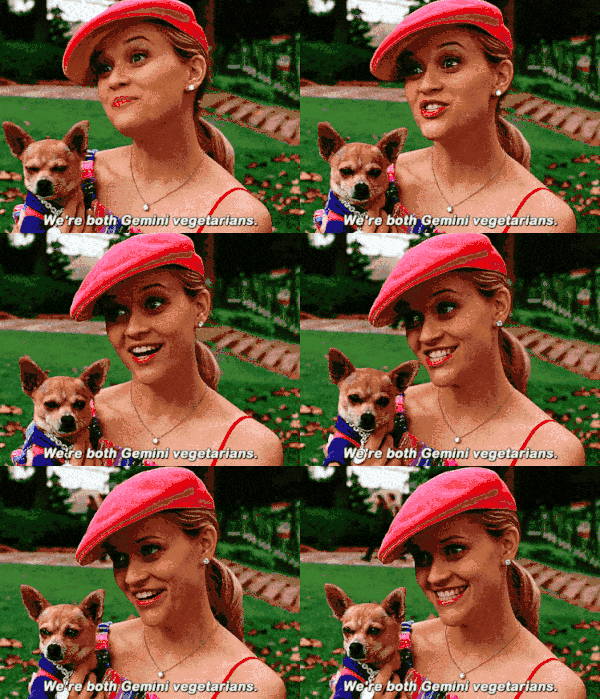
From Legally Blonde (2001), dir. Robert Luketic, based on the novel by Amanda Brown
There are many reasons someone could be genAI-vegetarian, which can lead to slightly different definitions of “consuming the products of genAI”; and like any philosophy, the reasons might conflict with other beliefs or habits or even with each other, influencing how far the person is willing to go for them. For instance, someone might just not like how genAI content feels, and so mostly ignore it. Another might take the Pope’s warning that genAI abuses God-given human faces and voices as an absolute dictum. A third still might be okay consuming the output of genAI tools, but want to avoid using them. Many such reasons and degrees of belief have parallels with food vegetarianism. And even if they are hard to digest, most of them will result in broadly similar day-to-day choices that aren’t too hard for others to respect: don’t serve the vegetarians meat, and when in doubt, ask.
(I guess you can never be absolutely sure something is vegetarian unless you’re a farm-to-plate purist. You have to trust whoever is labeling your food or writing your blog post. If I later find out that something I consumed wasn’t vegetarian, I don’t beat myself up for it, but I avoid that product or source in the future.)
I want to say a bit more about my own two primary reasons for going genAI-vegetarian, which are also behind my food vegetarianism: ethics and sustainability. (Both can be seen as “externalities”, i.e. when the benefits enjoyed by a few producers and consumers harm many non-parties to the transaction, who never consented.) The ethical one is more absolute for me, so it goes first. The existence of a chicken wing is predicated on at least the death of the chicken, and probably also a lifetime of its confinement under severe distress. Similarly, a chicken wings advertisement made with Nano Banana Pro is predicated on at least intellectual property theft (i.e., labor without wages, use without consent) from unknown thousands of artists and writers, and the corresponding suppression of their future contributions to humanity, and probably also the underpaid and traumatic work of unknown thousands of people labeling and sanitizing datasets. I feel that this is all inherently morally wrong. And not in a way that can easily be fixed by technological or legal innovation.
As for sustainability, it is not inherently unethical to consume a lot of natural resources if the payoff is commensurate. (It’s unfair if resources are being taken away from people with no say in the matter, but that’s a different issue.) I just personally don’t think the benefits of genAI are worth how much it is accelerating the climate crisis. Some people think genAI will, directly or indirectly, actually help solve the problem, but I think that’s very unlikely and far in the future, whereas the harms are here and now.
The examples I started with are pretty clear, but at the edges of my genAI-vegetarianism, I have to think harder about my reasons. Both reasons above are actually against the production of genAI tools in the first place; my consumption of their outputs is just the most direct lever I can press, and the only one entirely under my own control. This observation informs my approach towards software that uses genAI under the hood. Sometimes, I can just choose to not click the AI button. But otherwise, to what extent is the value I derive from the software due to genAI? And thus to what extent does my using the software contribute to the demand for genAI, that then drives its production? Some features like algorithmic feeds are a clear “no”, but in general, I think I have to answer these questions case-by-case. A hardcore take on them could be considered genAI-vegan.
Another important edge case is with AI-powered translation, text-to-speech, and speech-to-text tools. Although their AI does “generate” content, they feel qualitatively different from other freely generative tools like ChatGPT, and are less ethically fraught (or so it seems to me). (While you can use ChatGPT to translate, here, I’m talking specifically about domain-specific tools like DeepL.) They rely on specialized parallel-corpus training data (e.g., podcasts with human-written transcriptions, legal documents in multiple languages) that is largely produced by corporations and governments who have already paid the people who made them. They may be trained on other, monolingual content scraped from the web, but are not aimed to substitute for it. Plus, while they are taking many less-creative future jobs away from their human counterparts, I would guess that works of literature will continue to be translated by humans and animated movies will continue to be voice-acted by humans. Once I’m satisfied that these tools are not founded on moral wrongs, I’m open to a more nuanced consideration of whether mitigating disabilities and language barriers is worth the large climate cost. I think it is.
I now realize I should stop using software developed using genAI, but at first, I tried to make excuses. Then I realized there’s a secret third reason behind my vegetarianism, genAI or otherwise: customary practice. I’ve lived my whole life so far consuming neither meat nor AI-generated content and see no reason to start. But because I’ve belonged my whole life to communities that don’t consume meat as a simple matter of custom, being vegetarian hasn’t made me change how I’ve always lived. Being genAI-vegetarian is starting to. More and more software developers are using genAI tools these days in ways that turn me away from their products to various degrees. On one end of the spectrum, “vibe-coded” software is clearly not vegetarian, as I see little difference between reading genAI-written code and running it. On the other end, if a developer uses a chatbot to generate prose summaries of failing test cases before fixing them themselves, I would tend to say it is the developer who is consuming genAI output, not me. I fear, however, that these nuances are irrelevant when some of my everyday software workhorses—Firefox? iOS?—are already tainted. Although I’m dragging my feet, I’ve slowly started exploring how to switch away, reassuring myself that some action is better than none. I admire and can finally empathize with people who turn vegetarian later in life.
I don’t mean to convince anyone of anything with this essay, but only to explain my own position that I will likely refine as I go. Thirty years ago, when my parents first moved to America, their vegetarianism that was perfectly normal in India was suddenly novel to those around them. They had to keep explaining themselves and answering questions like “but do fish feel pain?”, and “but what if you didn’t know?”, and so on. Today, my own vegetarianism is rarely questioned—maybe a consequence of who my circles are and where I live and travel, or maybe of higher general acceptance and adoption. I wish that more personal choices about how you live your life didn’t necessarily need to be explained to be accepted. But I suspect we aren’t there yet for genAI-vegetarianism, so I’ll be glad to discuss.
Many thanks to Evan Caragay, Rujul Gandhi, Aalok Sathe, Mandar Juvekar, Jonathan Melville, Clément Pit-Claudel, Aniruddha Chiplunkar, and Basil Contovounesios for helping hone this essay and the ideas that went into it.
After having written this essay, I was glad to learn that I’m not the only one to have made this analogy! Software developer Simon Willison floated the idea of “AI veganism” on his blog (warning: other sections of the linked article contain AI-generated images, but more as mention than as use) in August 2022; David Joyner, administrator and computer science educator at Georgia Tech, proposed the term again in a short popular science article in The Conversation in July 2025; and Sean Boots, who works on technology in Canadian government, blogged about his own “generative AI vegetarianism” in March 2026, listing a variety of possible reasons and other people’s takes on AI. Interestingly, all three focus on the use of genAI, not the consumption of its outputs.
– Shardul Chiplunkar
first published Feb 23, 2026
last updated Mar 25, 2026